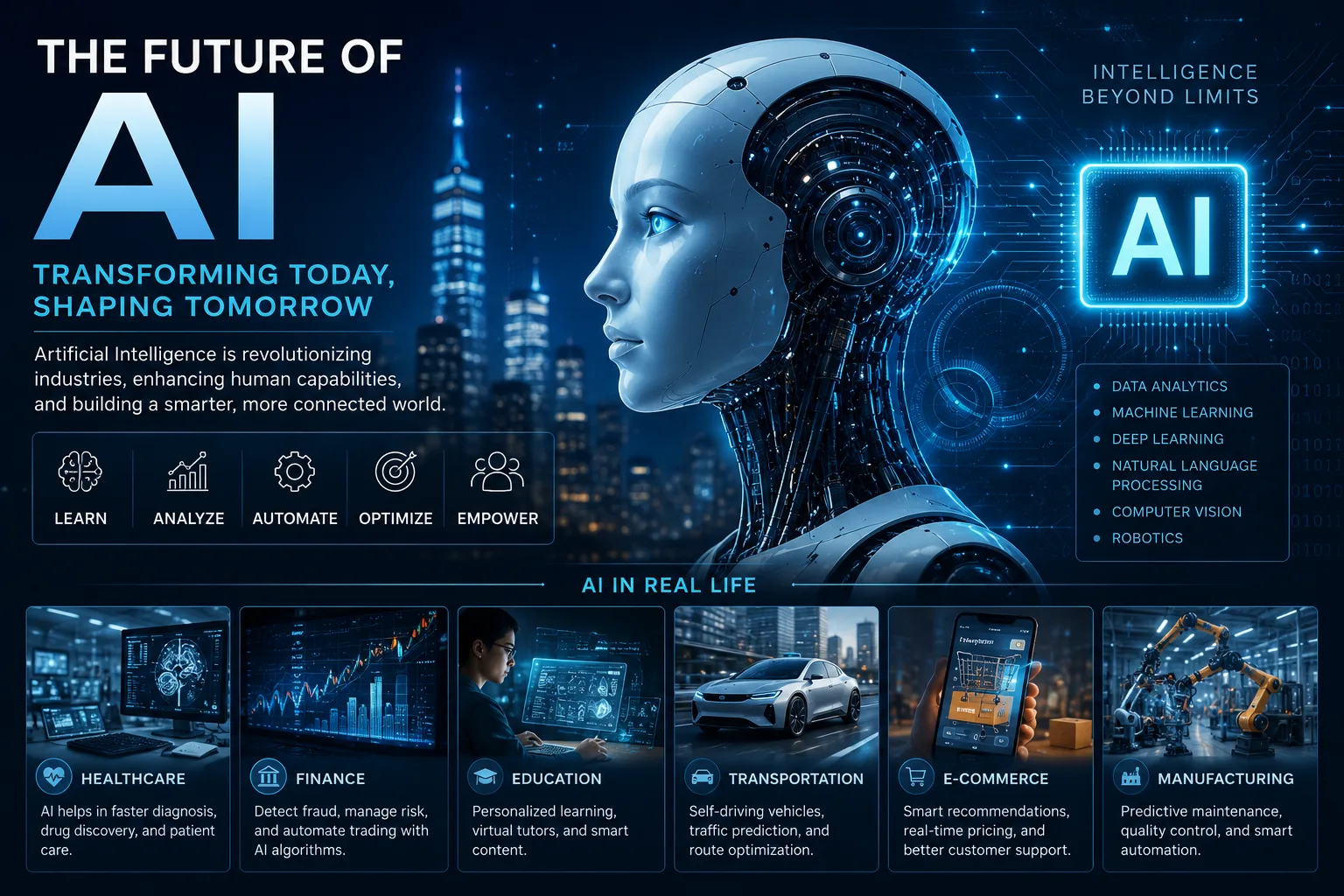
Introduction
Artificial Intelligence (AI) has evolved from a futuristic concept into one of the most transformative technologies of the 21st century. What was once confined to science fiction is now deeply integrated into our daily lives. From unlocking smartphones with facial recognition to receiving personalized recommendations on streaming platforms, AI influences countless decisions and experiences every day.
In 2026, AI is no longer just a competitive advantage—it has become a business necessity. Organizations across healthcare, finance, education, manufacturing, retail, and transportation are adopting AI-driven solutions to automate workflows, improve efficiency, reduce operational costs, and deliver better customer experiences.
This guide explores what Artificial Intelligence is, how it works, its different branches, real-world applications, advantages, challenges, ethical concerns, and future trends that are shaping the next generation of intelligent systems.
What is Artificial Intelligence?
Artificial Intelligence refers to computer systems designed to perform tasks that typically require human intelligence. These tasks include learning from experience, recognizing images, understanding speech, translating languages, making predictions, solving complex problems, and even generating creative content.
Unlike traditional software that follows predefined instructions, AI systems learn from data. The more quality data they receive, the better they become at making accurate decisions.
"Artificial Intelligence is not about replacing human intelligence—it's about augmenting it."
Core Characteristics of AI
- Learning from historical data
- Pattern recognition
- Decision making
- Problem solving
- Natural language understanding
- Computer vision
- Automation of repetitive tasks
- Continuous improvement through training
How Artificial Intelligence Works
Most AI systems follow a structured pipeline to convert raw data into actionable insights.
- Data Collection – Gathering structured and unstructured data.
- Data Cleaning – Removing duplicates and correcting errors.
- Model Training – Using algorithms to identify patterns.
- Testing – Evaluating model performance on unseen data.
- Deployment – Integrating the AI model into real-world applications.
- Continuous Learning – Updating the model with new information to improve accuracy.
The quality of an AI system largely depends on the quality, diversity, and volume of the data used during training.
Major Branches of Artificial Intelligence
1. Machine Learning (ML)
Machine Learning enables computers to learn patterns from historical data without explicit programming. ML powers spam filters, recommendation systems, fraud detection, predictive analytics, and customer segmentation.
2. Deep Learning
Deep Learning is a subset of Machine Learning that uses neural networks with multiple layers to process large amounts of data. It is responsible for significant advances in image recognition, speech recognition, autonomous driving, and generative AI.
3. Natural Language Processing (NLP)
NLP allows machines to understand, interpret, and generate human language. Applications include virtual assistants, chatbots, language translation, sentiment analysis, and document summarization.
4. Computer Vision
Computer Vision enables machines to interpret visual information from images and videos. It is widely used in facial recognition, medical imaging, manufacturing quality inspection, and autonomous vehicles.
5. Robotics
AI-powered robots can perform repetitive, dangerous, or highly precise tasks in manufacturing plants, warehouses, hospitals, and space exploration missions.
Real-World Applications of AI
Healthcare
Artificial Intelligence is revolutionizing healthcare by improving diagnostic accuracy, reducing administrative workload, and accelerating medical research.
- Disease prediction
- Medical image analysis
- Drug discovery
- Virtual health assistants
- Patient monitoring
- Personalized treatment plans
Finance
Banks and financial institutions use AI to enhance security, improve customer service, and automate financial operations.
- Fraud detection
- Risk assessment
- Algorithmic trading
- Loan approval systems
- Customer support chatbots
Education
Educational platforms leverage AI to personalize learning experiences and improve student engagement through adaptive learning technologies.
- Personalized learning paths
- Automated grading
- Virtual tutors
- Language learning assistants
- Learning analytics
E-Commerce
Online retailers rely heavily on AI to recommend products, optimize pricing strategies, forecast demand, and enhance customer support.
- Product recommendations
- Visual search
- Inventory forecasting
- Customer behavior analysis
- Dynamic pricing
Manufacturing
Factories use AI to improve production quality, predict equipment failures, and optimize supply chains.
- Predictive maintenance
- Quality inspection
- Production optimization
- Warehouse automation
Benefits of Artificial Intelligence
| Benefit | Description |
|---|---|
| Automation | Reduces repetitive manual work. |
| Accuracy | Minimizes human errors in repetitive tasks. |
| Speed | Processes millions of records within seconds. |
| Availability | AI services can operate 24/7. |
| Personalization | Provides tailored recommendations for users. |
| Cost Savings | Optimizes operations and reduces expenses. |
Challenges and Risks
Although AI provides numerous advantages, organizations must also address significant challenges.
Privacy
AI systems often rely on large datasets containing personal information. Proper data protection policies are essential to maintain user trust.
Bias
If training data contains biases, AI models may produce unfair or discriminatory outcomes. Responsible AI development requires diverse and representative datasets.
Security
AI systems can become targets of cyberattacks, adversarial inputs, and data manipulation. Continuous monitoring and robust security practices are necessary.
Job Transformation
Rather than eliminating all jobs, AI is reshaping the workforce by automating repetitive tasks while increasing demand for creative, technical, and strategic roles.
Ethical Considerations
Responsible AI development involves transparency, accountability, fairness, privacy protection, and human oversight. Organizations should ensure AI decisions are explainable and regularly audited for bias and safety.
- Transparency
- Accountability
- Human oversight
- Privacy protection
- Fairness
- Responsible data usage
Future Trends in AI
Generative AI
Generative AI is enabling businesses to create text, images, videos, code, music, and designs with unprecedented efficiency.
AI Agents
Autonomous AI agents are becoming capable of planning tasks, interacting with software tools, and completing complex workflows with minimal human intervention.
Edge AI
Instead of processing data only in cloud servers, Edge AI performs computations directly on devices such as smartphones, cameras, and IoT sensors, reducing latency and improving privacy.
Explainable AI
Organizations increasingly require AI systems to explain why a particular prediction or recommendation was made, especially in regulated industries.
Industry-Specific AI
Customized AI solutions designed specifically for healthcare, legal services, finance, education, agriculture, and manufacturing are expected to grow significantly over the coming years.
Best Practices for Businesses
- Start with clearly defined business problems.
- Invest in high-quality datasets.
- Ensure strong cybersecurity measures.
- Maintain human oversight for critical decisions.
- Continuously monitor model performance.
- Comply with privacy regulations.
- Train employees to work alongside AI technologies.
Frequently Asked Questions
Is AI replacing humans?
AI is primarily automating repetitive tasks while enabling humans to focus on creativity, innovation, leadership, and strategic thinking.
Can small businesses use AI?
Yes. Cloud-based AI services and affordable software platforms have made AI accessible for startups and small businesses.
What skills are important in an AI-driven future?
Critical thinking, data literacy, programming, communication, creativity, and adaptability are becoming increasingly valuable.
Conclusion
Artificial Intelligence represents one of the most significant technological revolutions in modern history. From improving healthcare and transforming education to optimizing business operations and enabling scientific discoveries, AI is reshaping every industry.
As AI technologies continue to evolve, organizations must focus on responsible adoption, ethical development, and continuous innovation. Businesses that embrace AI strategically while maintaining transparency and human oversight will be better positioned to compete in the digital economy.
The future of Artificial Intelligence is not about machines replacing people—it is about humans and intelligent systems working together to solve complex problems, unlock new opportunities, and create a smarter, more connected world.
Discussion (0)
No comments yet. Be the first to join the conversation!