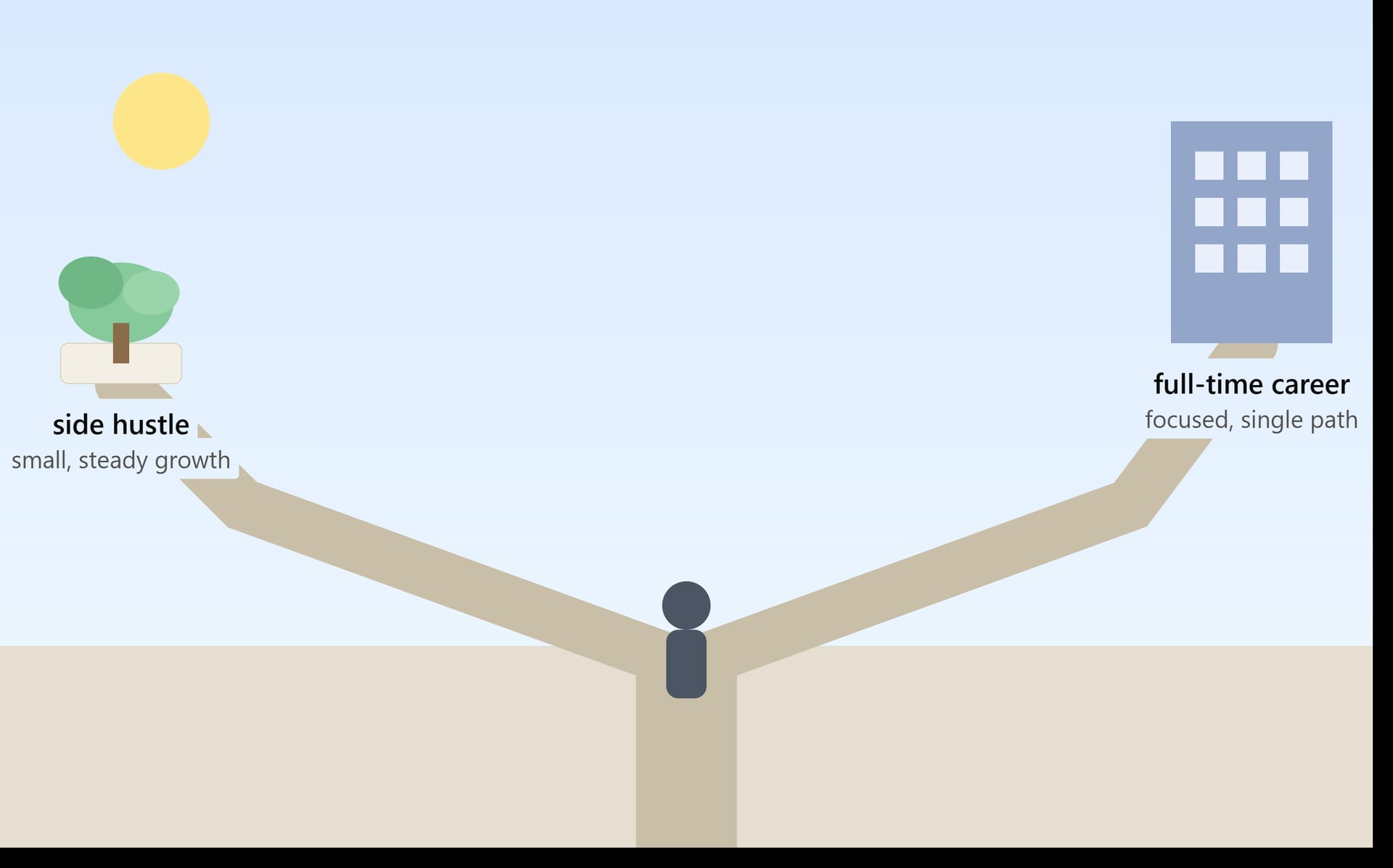
There's a moment almost everyone hits eventually: you're doing fine in your career, but there's this other thing pulling at you — a business idea, a creative passion, a skill you could monetize. So you're left staring down two paths. Do you keep it as a side hustle, something you build in the evenings and weekends? Or do you go all-in, quit the safety net, and bet everything on one path?
There's no universally "right" answer here. But there is a right answer for you, depending on your finances, risk tolerance, and what you're actually trying to build. Let's break it down.
The Case for a Side Hustle
1. You keep your safety net.
A steady paycheck means rent gets paid and you can experiment without the pressure of needing your new venture to work immediately. That breathing room often leads to better decisions, not worse ones.
2. You can test ideas cheaply.
A side hustle is basically a low-risk research and development phase for your life. You find out if there's real demand, if you actually enjoy the day-to-day work, and if the idea has legs — all before burning your savings on it.
3. Diversified income is real security.
Relying on one income stream is its own risk. A side hustle that grows into a second stream of income can make you more financially resilient, not less.
4. It's sustainable for the long haul.
Not every good idea needs to become your full-time job. Some of the best side projects stay side projects forever — profitable, enjoyable, and pressure-free — precisely because they were never forced to carry your entire livelihood.
The tradeoff: Time and energy are finite. Working a full-time job and building something else means less sleep, less downtime, and slower progress on the thing you actually care about. Side hustles can also stall out in "hobby" mode if you never give them the attention that turns them into something bigger.
The Case for Going All-In
1. Full focus accelerates growth.
There's a reason so many successful founders and creators point to the moment they went all-in as the turning point. Undivided attention compounds. Problems get solved faster. Momentum builds faster.
2. Urgency changes your decision-making.
When there's no fallback, you make sharper, faster decisions. Half-measures disappear because they can't afford to exist.
3. You remove the "day job as excuse" trap.
It's easy to let a side hustle stay small forever because the job absorbs your best hours and energy. Going all-in removes that excuse entirely.
4. Some opportunities are time-sensitive.
If you're in a fast-moving market or riding a wave of momentum (a viral audience, a narrow market window, early-mover advantage), waiting to "build it slowly on the side" might mean missing the window altogether.
The tradeoff: No safety net means real financial risk, higher stress, and pressure that can sometimes lead to worse decisions, not better ones — desperation is a bad business partner. Going all-in too early, before there's real signal that the idea works, is one of the most common ways good ideas get killed.
So How Do You Actually Decide?
Ask yourself these questions honestly:
- Do I have proof of demand yet, or just a hunch? If it's still a hunch, side hustle mode is how you test it safely.
- How much financial runway do I have? Going all-in without at least 6–12 months of expenses saved is a very different bet than doing it with two years of runway.
- Is this idea time-sensitive? Some windows close. Most don't.
- What does my life actually allow right now? Kids, health, a mortgage — these aren't excuses, they're real constraints that deserve respect in the decision.
- Am I chasing this out of excitement, or out of escape? Wanting out of a job you hate is a different motivation than being pulled toward something you love — and it leads to different outcomes.
The Honest Middle Ground
Most people don't make one clean jump. The more common — and often smarter — path looks like this:
- Start as a side hustle.
- Get to a point of real, repeatable proof: paying customers, consistent revenue, a genuine signal that this works.
- Build a financial cushion.
- Then go all-in, once the risk has been meaningfully reduced.
Going all-in isn't braver than staying on the side — and staying on the side isn't safer than going all-in. Each path just carries a different kind of risk. The goal isn't to pick the "bold" option or the "safe" option. It's to pick the one that matches where you are right now, and to be honest with yourself about when it's time to switch lanes.
What's pulling at you right now — is it still an idea, or is it starting to look like proof?
Discussion (0)
No comments yet. Be the first to join the conversation!