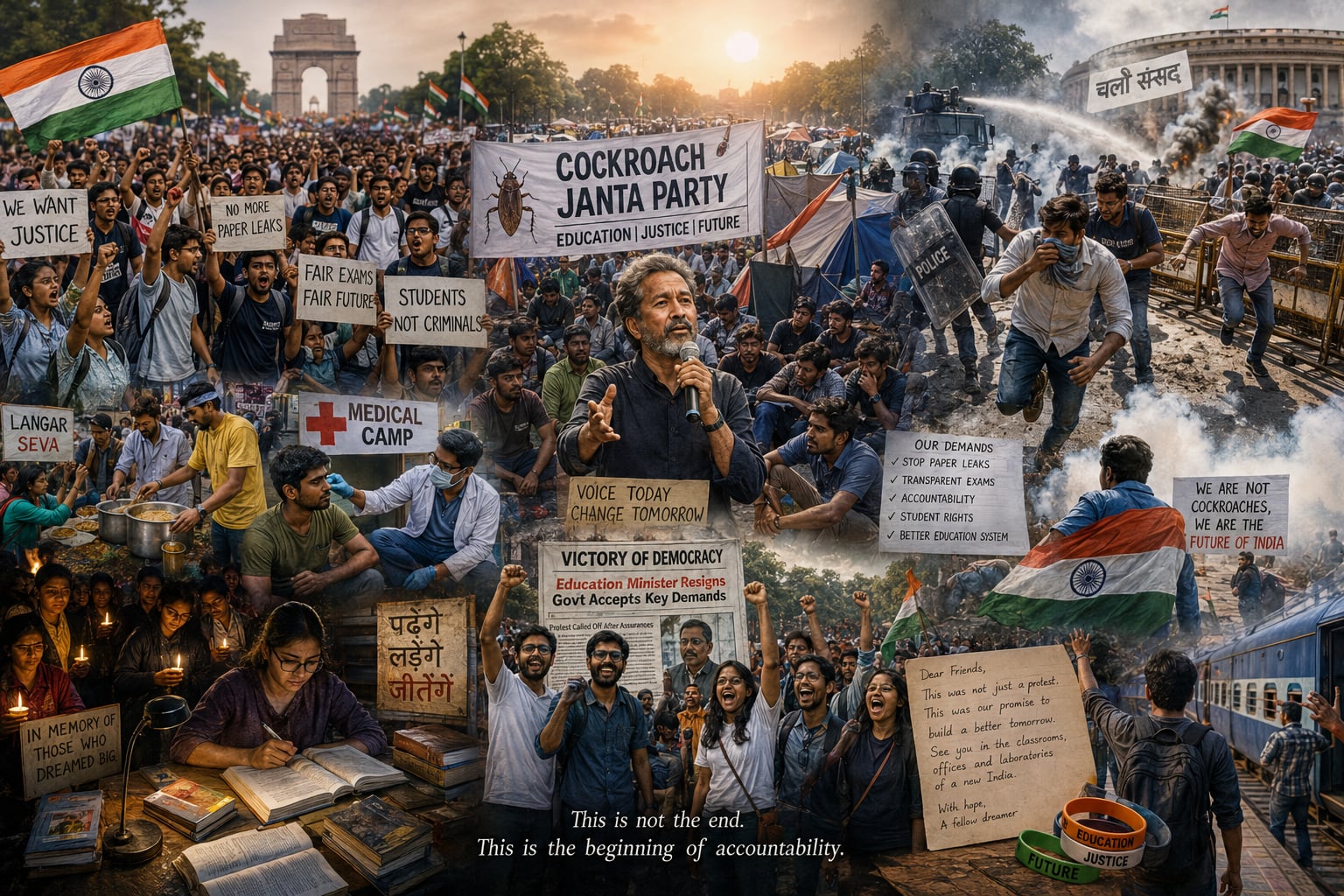
When a Generation Rose: The Summer That Changed India
"History is rarely written by those who stay silent. Sometimes, it is written by ordinary people who decide they have had enough."
The summer of 2026 marked one of the most significant youth-led civic movements in recent Indian history. What began as growing frustration over repeated examination controversies gradually evolved into a nationwide campaign demanding greater transparency, accountability, and fairness in India's education system.
Thousands of students from across the country travelled to New Delhi to participate in demonstrations centred around Jantar Mantar, a location long associated with peaceful public protests. Many participants were first-time protesters—students preparing for competitive examinations, recent graduates, job aspirants, and young professionals who believed that confidence in public examinations had been seriously weakened by recurring allegations of paper leaks and administrative failures.
They arrived carrying backpacks filled with books, handwritten placards, water bottles, and the hopes of families who viewed education as the primary pathway toward economic opportunity. Coming from different states, languages, cultures, and educational backgrounds, they found themselves united by a common demand: a transparent and trustworthy examination system.
Over the following days, the gathering expanded beyond students alone. Teachers, parents, retired civil servants, lawyers, doctors, education activists, and members of civil society also joined demonstrations or expressed support for the movement. Volunteer groups organised food distribution, medical assistance, legal aid, and sanitation facilities as the protest site grew larger.
What had initially appeared to be another public demonstration soon developed into a broader national discussion about educational governance, institutional accountability, and the future of millions of young Indians whose careers depended on competitive examinations.
The Build-Up to a National Protest
The movement did not emerge overnight. For months, concerns had been growing among students regarding examination integrity, recruitment delays, allegations of paper leaks, and the perceived lack of accountability following repeated controversies. These concerns affected candidates preparing for major entrance examinations and government recruitment processes across India.
For many students, competitive examinations represent years of disciplined preparation and considerable financial sacrifice. Families often invest their savings in coaching, accommodation, study materials, and relocation to educational hubs. Any doubts surrounding examination fairness therefore carried consequences extending far beyond individual test results.
Across social media platforms, thousands of students began sharing personal experiences describing uncertainty, disappointment, financial pressure, and emotional stress. Hashtags demanding accountability rapidly gained momentum, transforming scattered online conversations into coordinated discussions among student groups across multiple states.
Gradually, online campaigns evolved into local meetings, peaceful gatherings, and coordinated demonstrations. Student organisations began communicating with one another, volunteers established regional coordination teams, and legal experts started advising participants on conducting peaceful protests within constitutional limits.
Although different organisations participated in the demonstrations, the central demands remained remarkably consistent:
- Fair and transparent public examinations.
- Independent investigations into alleged irregularities.
- Institutional accountability wherever misconduct was established.
- Comprehensive reforms to strengthen examination security.
- Greater protection for the future aspirations of students.
Jantar Mantar Becomes the Symbol
As demonstrations expanded, Jantar Mantar emerged as the symbolic centre of the movement. Students gathered daily to listen to speeches, participate in discussions, and coordinate future activities. Volunteers established medical tents, distributed drinking water, organised food supplies, and assisted participants arriving from different parts of the country.
Throughout the protest site, handwritten banners reflected a common message: the demand for a fair education system rather than partisan political confrontation. Participants repeatedly described the demonstrations as a movement intended to restore trust in institutions responsible for conducting public examinations.
The atmosphere combined peaceful protest with civic participation. Students spent their mornings attending meetings, afternoons interacting with journalists and visitors, and evenings discussing examination reforms and future strategies. Many continued preparing for upcoming examinations while participating in demonstrations, studying from textbooks between protest activities.
20 July 2026: A Turning Point
On 20 July 2026, the demonstrations reached a critical stage. As groups of protesters attempted to march toward Parliament, authorities implemented extensive security arrangements around central New Delhi. Barricades were erected, movement restrictions were imposed in several locations, and police sought to prevent demonstrators from entering restricted areas. :contentReference[oaicite:0]{index=0}
During the confrontation that followed, police used crowd-control measures including water cannons, tear gas, and baton charges to disperse sections of the gathering, according to multiple news reports. Protesters alleged that excessive force had been used against peaceful demonstrators, while police stated that their actions were necessary to maintain public order and enforce restrictions. :contentReference[oaicite:1]{index=1}
Images and videos recorded throughout the day spread rapidly across television broadcasts and social media platforms. The events transformed what had largely been an education-sector protest into a national political discussion, drawing widespread public attention and prompting responses from opposition leaders, education experts, and civil society organisations. :contentReference[oaicite:2]{index=2}
The Protest Continues
Despite the confrontation, demonstrators returned to Jantar Mantar in the days that followed. Volunteers rebuilt protest camps, resumed food distribution, and continued coordinating medical assistance for participants.
Symbolic hunger strikes also began, with several students stating that they intended to continue peaceful demonstrations until meaningful action was taken on their demands. The protest site became increasingly organised, with volunteers managing logistics, maintaining cleanliness, assisting visitors, and coordinating communication through social media platforms. :contentReference[oaicite:3]{index=3}
As participation expanded across multiple states, the movement gained sustained national media attention. Demonstrations were organised in numerous cities, while universities, coaching centres, alumni groups, and professionals expressed varying degrees of support for examination reforms and institutional accountability. :contentReference[oaicite:4]{index=4}
A New Chapter Begins
During this period, a youth-led organisation known as the Cockroach Janta Party (CJP) emerged as a prominent coordinating platform for many demonstrators. Originally adopting a name intended as a satirical response to criticism directed at protesters, the group evolved into one of the movement's most recognisable public faces. :contentReference[oaicite:5]{index=5}
Its volunteers helped coordinate demonstrations, communicate protest schedules, organise volunteers, and amplify student voices through social media. As participation increased, the movement gradually transformed from a series of local protests into a coordinated nationwide campaign demanding systemic reforms in India's education sector. :contentReference[oaicite:6]{index=6}
Next: The protests spread across India. Volunteers organised one of the largest youth-led civic movements in recent years. Teachers, parents, professionals, and public figures joined the cause, and Jantar Mantar became the centre of a movement that would soon capture national attention.
Part 2 — Building the Movement
How a student protest grew into one of India's largest youth-led civic movements.
"Every movement begins with a few voices. It grows when those voices discover they are not alone."
From Protest to Organisation
What initially appeared to be a series of isolated demonstrations soon evolved into a coordinated nationwide movement. Students from universities, coaching centres, and examination hubs began connecting through messaging platforms, social media communities, volunteer networks, and local organisers.
Rather than relying on a single leadership structure, volunteers divided responsibilities across multiple teams. Some coordinated transportation for students travelling to New Delhi, while others managed accommodation, food distribution, medical assistance, legal support, and media communication.
According to Reuters and the Associated Press, one of the most recognisable groups to emerge during this period was the Cockroach Janta Party (CJP). The name originated as a satirical response to criticism directed at unemployed youth but gradually became the public identity of the wider student movement. Supporters adopted the symbol as a message that ordinary citizens could not easily be ignored. :contentReference[oaicite:0]{index=0}
Although individual organisations maintained their own structures, the broader campaign remained centred on common demands: examination reforms, greater transparency, institutional accountability, and protection of students' futures.
Volunteers Keep the Protest Alive
As attendance at Jantar Mantar increased, volunteers transformed the protest site into a carefully organised civic space.
- Medical camps treated participants suffering from dehydration and exhaustion.
- Community kitchens distributed meals throughout the day.
- Volunteers supplied drinking water and essential medicines.
- Legal teams advised demonstrators on their constitutional rights.
- Student coordinators registered new arrivals and connected them with regional groups.
- Cleaning teams worked throughout the day to maintain sanitation around the protest site.
Many participants had travelled hundreds of kilometres to reach Delhi. Some carried sleeping bags and tents, while others relied on support from local volunteers who offered temporary accommodation. Donations from ordinary citizens helped sustain daily operations, reflecting growing public sympathy for the movement. :contentReference[oaicite:1]{index=1}
A Movement Spreads Across India
While Jantar Mantar remained the symbolic centre of the demonstrations, protests soon expanded far beyond the national capital.
Universities, coaching institutes, and public spaces in multiple states witnessed peaceful marches, candlelight vigils, human chains, discussion forums, and solidarity gatherings. Students unable to travel to Delhi organised local demonstrations while sharing photographs, speeches, and updates online.
As participation increased, the campaign evolved into one of the largest youth-led civic movements in recent years. International news organisations reported that demonstrations reflected not only concerns over examination integrity but also broader anxieties about employment opportunities, institutional trust, and the future facing India's younger generation. :contentReference[oaicite:2]{index=2}
The Power of Social Media
Digital platforms became the movement's primary communication network.
Volunteers published schedules for demonstrations, coordinated transport, shared legal guidance, livestreamed speeches, and quickly corrected misinformation circulating online. Independent creators, student journalists, and participants documented events in real time, allowing millions of people across the country to follow developments as they unfolded.
Images of students studying from textbooks between protest activities, volunteers distributing food, and doctors treating exhausted demonstrators were widely shared across social media. These moments helped shape public perception of the movement as peaceful, disciplined, and focused on educational reform. :contentReference[oaicite:3]{index=3}
Support Beyond Students
As the demonstrations continued, support expanded beyond student communities.
Teachers, retired educators, lawyers, doctors, parents, alumni groups, former civil servants, and education reform advocates visited protest sites or publicly expressed solidarity. Many described the debate as extending beyond individual examinations to the credibility of public institutions responsible for evaluating millions of students every year.
This widening support transformed the demonstrations from a student protest into a broader public discussion about educational governance and institutional accountability. :contentReference[oaicite:4]{index=4}
Sonam Wangchuk Joins the Movement
A major turning point came when education reformer and environmental activist Sonam Wangchuk joined the demonstrations at Jantar Mantar.
Wangchuk, widely recognised for his work on education reform and sustainable development, expressed support for students demanding transparency and accountability. His presence attracted significant national and international media attention, bringing additional visibility to the movement. Reuters and BBC News reported extensively on his participation and public appeals for peaceful democratic engagement. :contentReference[oaicite:5]{index=5}
Addressing demonstrators, Wangchuk encouraged participants to maintain non-violent discipline and emphasised that lasting reform would require both public participation and institutional commitment. His speeches became some of the most widely shared moments of the protest movement. :contentReference[oaicite:6]{index=6}
The Hunger Strike
As negotiations with authorities continued without a comprehensive resolution, symbolic hunger strikes began at the protest site.
Several student leaders and volunteers participated, describing the fast as a peaceful expression of their determination. Sonam Wangchuk later joined the hunger strike, stating that the movement should remain entirely non-violent while continuing to seek accountability and reforms through democratic means. Reuters documented his participation during the sit-in at Jantar Mantar. :contentReference[oaicite:7]{index=7}
Medical teams regularly monitored participants, while volunteers requested demonstrators to prioritise health and avoid unnecessary risks.
Life Inside Jantar Mantar
Each day followed a rhythm of organisation and resilience.
Morning meetings outlined schedules and responsibilities. Throughout the afternoon, speakers addressed crowds while journalists interviewed participants from different states. Volunteers coordinated logistics, distributed meals, and welcomed new arrivals. As evening approached, students gathered for discussions, cultural performances, patriotic songs, and candlelight assemblies.
Perhaps the most striking images were those of students opening textbooks after protest activities, continuing preparations for examinations that had originally brought them to the streets.
For many observers, these scenes came to symbolise a generation determined not to abandon either its education or its democratic right to seek reform.
The Nation Begins Watching
Within weeks, the demonstrations dominated television broadcasts, newspaper front pages, and online discussions. International media organisations including Reuters, the Associated Press, Financial Times, ABC Australia, and BBC News covered developments as the movement continued to expand. :contentReference[oaicite:8]{index=8}
What had begun as frustration over examination controversies had become a national conversation about education, governance, accountability, and the aspirations of India's young people.
Then came the day that changed everything...
On 20 July 2026, thousands of protesters began marching toward Parliament. By sunset, images from New Delhi would dominate television screens, social media feeds, and newspaper front pages across the country. The movement had entered a new chapter—one that neither the protesters nor the government could ignore.
Part 3 — The Day That Changed Everything
20 July 2026: The Parliament March That Brought India's Education Movement to a National Turning Point
"Some days become history because of the decisions governments make. Others become history because ordinary people refuse to go home."
The Morning of 20 July
The morning of 20 July 2026 began unlike any other day in New Delhi. It was the opening day of Parliament's Monsoon Session, and thousands of students had gathered around Jantar Mantar after weeks of demonstrations demanding reforms in India's examination system.
For days, organisers had announced a peaceful "Chalo Sansad" (March to Parliament) programme. Their objective, they said, was to take their demands closer to the country's lawmakers while maintaining a non-violent demonstration.
Authorities, however, had already denied permission for the march. Delhi Police imposed extensive security arrangements across central Delhi, erected barricades on major roads leading toward Parliament, increased deployment of security personnel, and warned protesters that movement into restricted areas would not be permitted. Reuters reported that officials anticipated a possible confrontation and tightened security ahead of the march. :contentReference[oaicite:0]{index=0}
Thousands Begin Marching
Shortly after the morning assemblies concluded, groups of protesters began moving away from Jantar Mantar in coordinated batches. Students carried Indian flags, handwritten banners, and placards demanding accountability, transparent examinations, and institutional reforms.
Participants repeatedly raised slogans calling for peaceful democratic action while volunteers instructed demonstrators to avoid provoking security personnel or damaging public property.
As the crowds advanced through central Delhi, additional groups from nearby locations joined the procession. According to Reuters, thousands of young people participated, making it one of the largest youth demonstrations witnessed in the capital in recent years. :contentReference[oaicite:1]{index=1}
The Barricades
The first major confrontation occurred when protesters reached heavily barricaded routes leading toward Parliament.
Steel barricades, police vehicles, and multiple layers of security personnel blocked access to restricted zones. Officers repeatedly instructed demonstrators to disperse and informed them that permission for the march had not been granted.
Many protesters chose to remain seated on nearby roads, chanting slogans and requesting permission to continue peacefully. Others attempted to move around barricades, creating moments of tension between sections of the crowd and security personnel.
Police maintained that the restrictions were necessary because Parliament was in session and security arrangements around the complex could not be compromised. :contentReference[oaicite:2]{index=2}
The Confrontation
As pressure increased at several barricade points, police initiated crowd-control measures to disperse advancing groups.
Reuters and other international media reported that officers used tear gas shells, water cannons, and baton charges (lathi-charge) during clashes with demonstrators. Videos recorded throughout the day showed smoke filling sections of central Delhi as protesters attempted to regroup after being pushed back. :contentReference[oaicite:3]{index=3}
Many protesters alleged that excessive force had been used against people participating in what they described as a peaceful march. Delhi Police, meanwhile, stated that officers acted to enforce movement restrictions, restore public order, and prevent protesters from entering prohibited areas around Parliament. :contentReference[oaicite:4]{index=4}
Several protesters, police personnel, and journalists were reported injured during the day's events, although figures varied across different reports. :contentReference[oaicite:5]{index=5}
Images That Reached the Nation
Throughout the afternoon, television channels broadcast live footage from central Delhi while social media platforms filled with videos recorded by protesters, journalists, and bystanders.
Images of students running through tear gas, volunteers helping injured demonstrators, police pushing crowds away from barricades, and protesters waving the Indian flag rapidly spread across the country.
Many of these videos accumulated millions of views within hours, bringing the movement to audiences that had previously followed developments only through headlines.
International news organisations including Reuters, the Associated Press, Financial Times, and other global media outlets highlighted the confrontation as one of the biggest political challenges faced by Prime Minister Narendra Modi's government during its third term. :contentReference[oaicite:6]{index=6}
Political Reactions
The events of 20 July immediately triggered reactions across India's political spectrum.
Opposition parties criticised the police response and demanded accountability, while also renewing calls for examination reforms and the resignation of Union Education Minister Dharmendra Pradhan.
Government representatives defended the security measures, stating that authorities had a responsibility to protect Parliament and maintain law and order during the Monsoon Session. :contentReference[oaicite:7]{index=7}
In the days that followed, repeated disruptions inside Parliament reflected the growing political significance of the movement, with opposition lawmakers raising the issue during parliamentary proceedings. :contentReference[oaicite:8]{index=8}
The Protest Does Not End
Although the march had been stopped, the demonstrations themselves did not end.
Students returned to Jantar Mantar later that evening and resumed their sit-in protests. Volunteers reopened medical camps, distributed food and water, and continued supporting participants who remained at the protest site.
Movement leaders announced that demonstrations would continue peacefully despite the confrontation, insisting that their demands had not changed. Reuters reported that organisers vowed to continue nationwide protests following the clashes. :contentReference[oaicite:9]{index=9}
A Movement Impossible to Ignore
The events of 20 July transformed what had begun as an education-focused protest into one of the country's most closely watched political developments.
Public debate expanded beyond examination reforms to include questions about democratic protest, youth participation, government accountability, policing, and the future of India's education system.
Support demonstrations were organised in multiple cities, while lawyers, teachers, parents, professionals, and civil society organisations expressed differing views on both the protesters' demands and the authorities' response. :contentReference[oaicite:10]{index=10}
The movement had now become impossible to ignore.
Over the next five days, negotiations continued, Parliament remained under pressure, hunger strikes drew increasing public attention, and political developments accelerated. What followed would ultimately reshape the course of the movement—and become one of the most consequential moments in India's recent education policy debate. :contentReference[oaicite:11]{index=11}
Part 4 — Legacy: The Movement That Changed the Conversation
How weeks of student demonstrations concluded, what changed afterward, and the questions that continue to shape India's education debate.
"Every movement ends. Its impact is measured not only by what changed immediately, but also by the conversations it leaves behind."
A Turning Point in the Movement
After weeks of demonstrations, negotiations, public debate, and nationwide solidarity, the Education Rights Movement reached a significant turning point on 25 July 2026.
On that day, Union Education Minister Dharmendra Pradhan announced that he had resigned from his position. In his public resignation statement, Pradhan said his decision was made in the interest of students and the nation, while also referring to the controversy surrounding examination irregularities. :contentReference[oaicite:0]{index=0}
Reuters reported that the resignation followed weeks of sustained youth-led protests demanding accountability over examination paper leaks and broader reforms in India's examination system. Protest leaders described the announcement as a major achievement for the movement, while government officials continued discussions with representatives of the protesters. :contentReference[oaicite:1]{index=1}
Government Response
Following negotiations with protest representatives, the central government announced that it had accepted several key demands raised during the demonstrations. According to Reuters and the Associated Press, these commitments included reforms to strengthen examination processes, withdrawal of police cases filed against many protesters, and financial assistance for families of students whose deaths had become part of the wider public debate surrounding examination pressures. :contentReference[oaicite:2]{index=2}
Officials stated that further administrative measures would be implemented through appropriate ministries and examination authorities. Protest organisers described these commitments as an important first step while emphasising that long-term implementation would remain essential.
The Hunger Strike Ends
Following the government's announcements and the minister's resignation, protest leaders announced the conclusion of the hunger strike at Jantar Mantar.
Education reformer Sonam Wangchuk, who had participated in the movement and later joined the hunger strike, urged demonstrators to end the protest peacefully after discussions with government representatives. He appealed to participants to celebrate responsibly and continue pursuing reforms through democratic and constitutional means. :contentReference[oaicite:3]{index=3}
For many participants, the conclusion of the hunger strike symbolised not the end of their concerns, but the completion of one phase in a larger campaign for educational reform.
Students Return Home
As protest camps gradually closed, thousands of students began returning to their hometowns and universities across India.
The scenes at Jantar Mantar changed rapidly. Temporary medical camps were dismantled, volunteer kitchens closed, and banners that had filled the protest site for weeks were carefully packed away.
Many students described mixed emotions. There was celebration over the immediate developments, but also recognition that meaningful reform would require sustained implementation long after the demonstrations had ended.
Volunteers thanked doctors, lawyers, teachers, sanitation workers, journalists, and ordinary citizens who had supported the movement throughout its duration.
Impact on India's Education Debate
Although the immediate demonstrations concluded, the movement significantly expanded public discussion about India's examination system.
Education experts, policymakers, universities, coaching institutions, and civil society organisations increasingly debated questions surrounding examination security, digital testing, recruitment transparency, institutional accountability, and student mental health.
Many commentators observed that the protests reflected broader concerns extending beyond a single examination. The movement highlighted the expectations of millions of young Indians whose educational and professional futures depend on competitive public examinations. :contentReference[oaicite:4]{index=4}
What Changed
- National attention focused on examination integrity and administrative accountability.
- The government announced a series of examination-related reforms following negotiations with protest representatives. :contentReference[oaicite:5]{index=5}
- The resignation of the Union Education Minister became one of the most significant political developments associated with the movement. :contentReference[oaicite:6]{index=6}
- The protests demonstrated the organisational capacity of student-led civic movements operating through both online and offline networks.
- The movement generated widespread public discussion about the relationship between education, employment opportunities, and institutional trust.
What Remained Unresolved
Even after the demonstrations ended, important questions remained.
Education policy experts noted that implementing examination reforms across India's vast education system would require sustained administrative effort, technological improvements, and continued public oversight.
Students also continued to call for long-term improvements in recruitment processes, examination security, grievance redressal mechanisms, and greater transparency across public institutions responsible for conducting competitive examinations.
Observers widely agreed that while the movement achieved several immediate objectives, its long-term legacy would ultimately depend on how successfully promised reforms were implemented in the years ahead.
A Legacy Beyond Protest
For many participants, the Education Rights Movement became more than a campaign about examinations.
It demonstrated how peaceful civic participation, volunteer networks, digital communication, and sustained public engagement could shape national conversations on issues affecting millions of young people.
Whether viewed as a political milestone, a student movement, or a broader call for institutional reform, the events of 2026 are likely to remain an important chapter in discussions about education and democratic participation in India.
The movement's legacy continues to be debated by policymakers, educators, students, and political observers. Its lasting impact will ultimately be judged not only by the protests themselves, but by the reforms that follow.
Final Reflection
"History remembers moments. People remember movements. But generations remember the day they found their voice."
The Education Rights Movement of 2026 brought together students, teachers, parents, professionals, and citizens from across India around a shared demand for fairness, transparency, and accountability. While opinions differ on its political significance, the movement undeniably placed education at the centre of the national conversation and demonstrated the influence that organised, peaceful civic participation can have in a democratic society. :contentReference[oaicite:7]{index=7}
Discussion (0)
No comments yet. Be the first to join the conversation!