🚨 Jantar Mantar Protest 2026: Why Thousands of Students Took to the Streets
On 20 July 2026, students and job aspirants protested at Jantar Mantar, New Delhi, demanding action against exam paper leaks, recruitment delays, and irregularities. The protest called for a fair, transparent, and accountable examination and recruitment system.
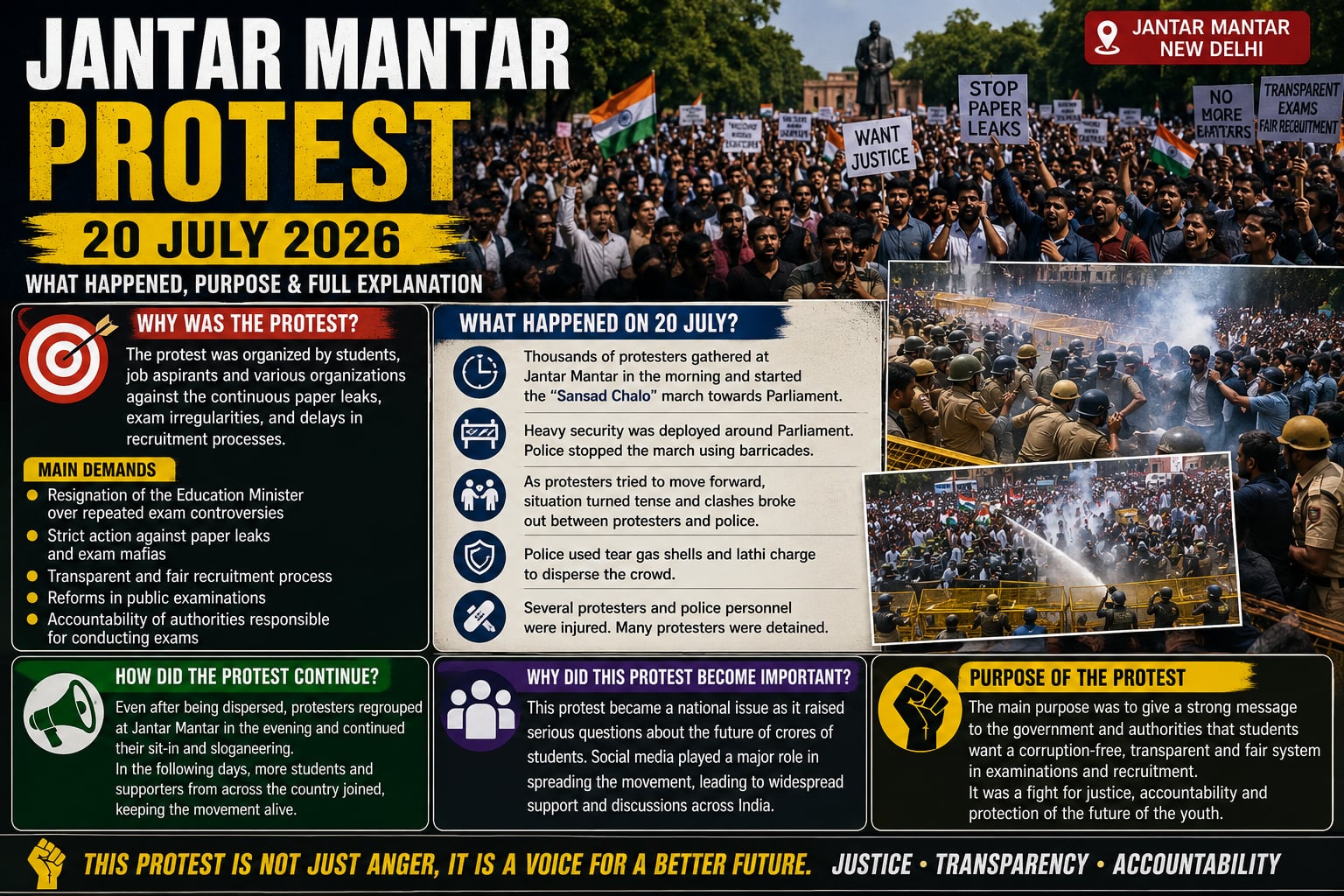
On 20 July 2026, New Delhi's Jantar Mantar became the center of one of the largest youth-led demonstrations in recent years. Thousands of students, job aspirants, activists, and supporters gathered to participate in the "Sansad Chalo" march. The protest gained nationwide attention after clashes between protesters and police, making it one of the most discussed public events of the year.
Why Was the Protest Organised?
The movement was mainly driven by concerns over the integrity of India's examination and recruitment system. Protesters alleged that repeated exam paper leaks, delays in recruitment, and a lack of accountability had damaged the future of millions of students and job seekers.
Some of the key demands included:
- Resignation of the Union Education Minister over repeated examination controversies.
- Strong action against paper leaks and exam irregularities.
- Transparent and fair recruitment processes.
- Reforms in public examinations and government hiring.
- Greater accountability from authorities responsible for conducting examinations.
What Happened on 20 July?
Thousands of protesters assembled at Jantar Mantar early in the morning before beginning a planned march towards Parliament under the banner of "Sansad Chalo." Security arrangements around Parliament were already very strict.
As the crowd attempted to move forward, Delhi Police stopped the march using barricades. The situation gradually became tense, and clashes broke out in several locations. Police used tear gas and batons (lathi charge) to disperse the crowd after the confrontation escalated. Authorities also reported injuries to police personnel, while many protesters claimed that excessive force had been used against them.
How Did the Protest Continue?
Although many demonstrators were dispersed during the day, the movement did not end. Protesters regrouped at Jantar Mantar later in the evening and continued raising slogans and demanding reforms. In the following days, more students and supporters from different parts of India joined the movement, making it even larger.
Why Did This Protest Become So Significant?
The protest attracted national attention because it reflected broader concerns among young people regarding education, employment opportunities, examination transparency, and government recruitment. Social media played a major role in spreading information, videos, and images from the protest, leading to widespread public discussion across the country.
The 20 July 2026 Jantar Mantar protest became an important moment in India's ongoing debate over education reforms and recruitment transparency. Supporters viewed it as a call for accountability and systemic reform, while authorities focused on maintaining public order and security. Regardless of differing opinions, the protest highlighted the growing concerns of many students and job aspirants about fairness, transparency, and trust in public examination and recruitment systems.
Advertisement
Enjoyed this article?
If you found this piece insightful, consider sharing it with your network or subscribing to the Ananta newsletter to get our best editorial analysis delivered straight to your inbox.
Discussion (0)
No comments yet. Be the first to join the conversation!