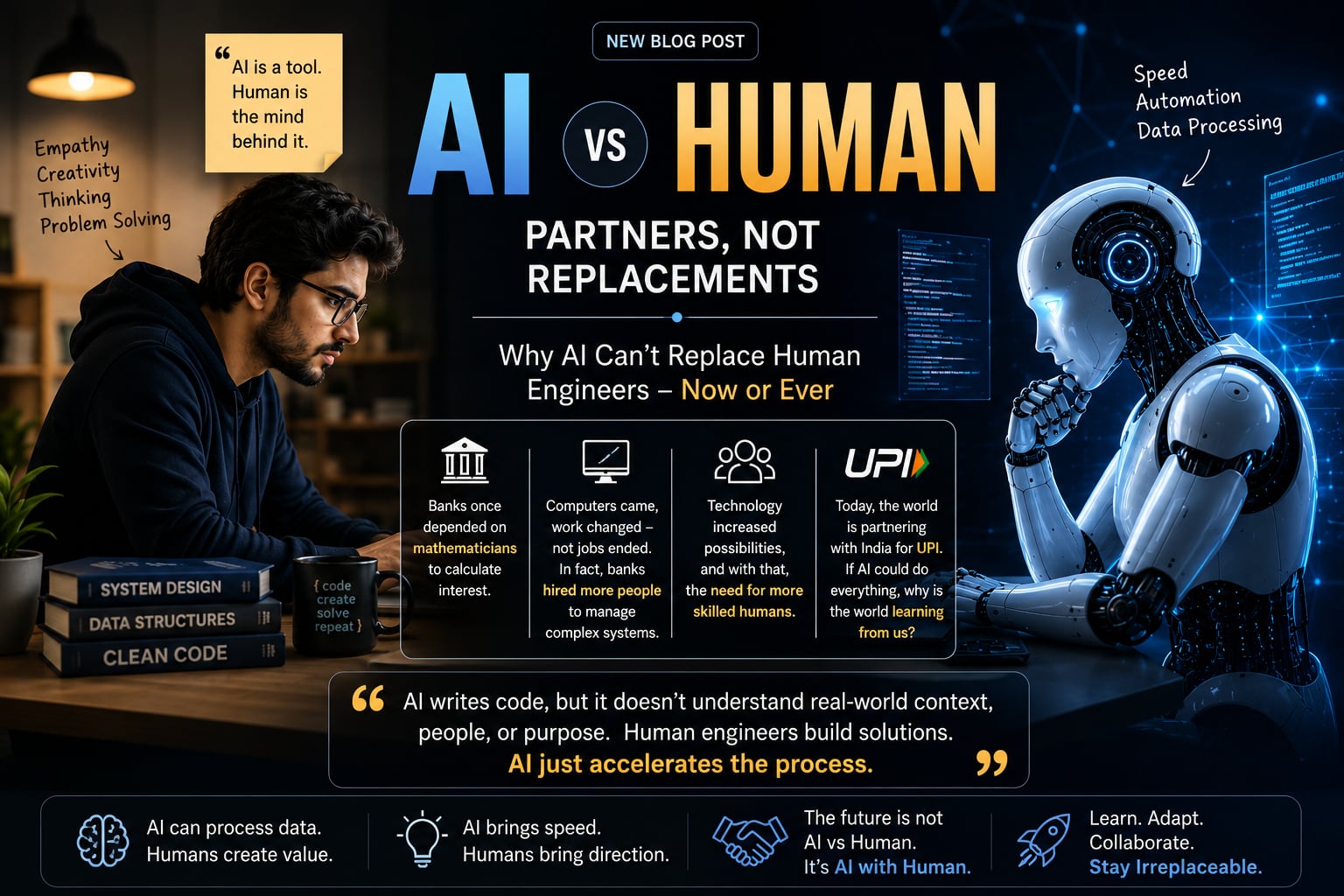
Tomorrow a new engineer joins our team. Before he had even started, he sent me a nervous message: he is afraid. Not of the work, not of the interview he already passed — he is afraid that by the time he becomes good at this, artificial intelligence will have swallowed the whole profession. “What is the point of learning to code,” he asked, “if AI will do all of it in a few years?”
If you are early in your career, you have probably felt some version of this. Every week a new model writes cleaner code, faster, than a room full of juniors. It is easy to look at that and conclude the ladder is being pulled up behind you. So let me say clearly what I told him, and why I am not worried — for him or for any of us.
AI is a tool. An extraordinary one. But a tool.
We have watched this exact movie before
The fear that a machine will end a profession is not new. It arrives with every powerful technology, and it always feels different this time. It never is. The pattern is remarkably consistent: a tool makes some task dramatically cheaper, everyone predicts the humans are finished, and then demand for those humans quietly grows — because the cheap tool unlocks work nobody could afford to do before.
You do not have to take my word for it. Look at the receipts history has already written.
The bank clerks who were supposed to disappear
Before computers, banks ran on human arithmetic. Armies of clerks and mathematicians posted ledgers by hand and calculated interest on every account. Month-end and year-end were brutal — people worked late under enormous pressure to close the books, because a single sum was a human being with a pen. When computers arrived, the prediction was obvious and confident: the clerks are finished.
Then something counterintuitive happened. As banks computerised and ATMs spread across the country, economist James Bessen documented that the number of bank tellers in the United States actually rose for decades. The reason is simple once you see it: automation made each branch cheaper to operate, so banks opened far more branches, and each branch still needed people — now doing sales, advice and relationship work instead of manual sums.
The machine did not delete the job. It changed what the job was for.
And here is the part the fear always misses. Because computers took over the drudgery of interest calculation, banks were suddenly free to imagine things that were impossible under a mountain of manual work: instant transfers, net banking, cards, real-time statements, loans approved in minutes. If computers had never been invented, we would very likely still be stuck with a passbook, a fixed deposit and an interest rate — not because the ideas were missing, but because the human workload made anything more ambitious impossible. Automation did not shrink banking. It exploded it, and it needed more people to run the bigger thing.
The spreadsheet did not kill the accountant
Run the same test on a tool you use every week. When the spreadsheet arrived, it automated exactly what accountants did all day: recalculating columns of numbers by hand. Surely accountants were done.
What actually happened is that routine, manual bookkeeping shrank — and the number of people doing higher-value financial analysis grew. The spreadsheet made “what if we changed this number?” cost almost nothing, so businesses ran a thousand scenarios they never would have paid a human to compute. The tool did not replace the professional. It promoted them — from human calculator to analyst and advisor.
Notice the shape of this, because it is the shape of your future too. The boring part got automated. The judgement part got more valuable.
The uncomfortable economics: cheaper code means more code
There is a 160-year-old idea that explains all of this, and every new developer should know its name. In 1865 the economist William Stanley Jevons noticed that when steam engines became more efficient and coal got cheaper to use, Britain did not burn less coal. It burned far more — because cheap coal made entirely new uses of coal worthwhile. This is the Jevons paradox: when you make a resource cheaper, total demand for it usually goes up, not down.
Software is a resource. AI is making it cheaper to produce. So what happens next is not “we need fewer engineers.” It is “we finally build the thousand things that were never worth the engineering cost before.” Every company sitting on a backlog of ideas they could not justify hiring for is about to find those ideas viable. That backlog is measured in decades. Someone has to design, direct, review, integrate, secure and maintain all of it — and a language model does not do that on its own.
What AI is genuinely good at vs. what still needs a human
| AI is genuinely strong at | Humans are still essential for |
|---|---|
| Writing boilerplate and first drafts | Deciding what is worth building and why |
| Explaining and translating code | Understanding messy, real-world requirements |
| Generating tests and documentation | System design and trade-off judgement |
| Refactoring within a clear spec | Owning correctness, security and consequences |
| Recalling patterns and syntax | Accountability when something goes wrong at 2am |
AI is fast at the middle of the work. Engineering lives at the two ends — figuring out what to build, and taking responsibility for what you shipped. Those ends are not getting automated any time soon.
The question I asked the fresher — and the UPI answer
Here is the question that made him pause. If AI can supposedly build anything, why are some of the richest, most advanced countries in the world — the UAE among them — lining up to adopt India’s UPI rather than simply generating their own payment system overnight?
UPI, India’s Unified Payments Interface, was built by people. It now processes billions of transactions a month, and country after country — the UAE, Singapore, Sri Lanka, Mauritius, Nepal, France and more — has moved to link up with it or adopt its rails. If software were the whole story, any wealthy nation with access to the same AI models could clone the code in a weekend.
But they do not, because the code was never the hard part. The hard, valuable part of UPI is everything around the code: the regulation, the trust, getting every bank to participate, dispute resolution, fraud control, and the network effect of hundreds of millions of people and merchants who already use it every day. That took years of human coordination to build, and no model can conjure it from a prompt. AI can write a payments API in minutes; it cannot manufacture a country’s trust in a payment network.
The lesson generalises: the value of real software is not the lines of code. It is the human system the code serves.
That is the whole argument in one example. When he saw it, he relaxed. The thing he was afraid of — that intelligence alone makes everything else worthless — is exactly backwards. The more intelligence becomes cheap and abundant, the more the scarce, human parts (judgement, trust, ownership, taste) are worth.
Let me be honest: the job will change
I am not going to tell you nothing changes, because that would be a comforting lie and you would catch me in it. It does change. The person who only ever wrote basic boilerplate and copied snippets is in a harder spot. The routine tier of the work is being automated, exactly like manual interest calculation and manual bookkeeping were.
But “the job changes” is not “the job disappears.” The clearest way to say it is this: AI will not replace engineers. Engineers who use AI will replace engineers who refuse to. That is a very different, and far more hopeful, statement — because which side of it you land on is entirely your choice.
So what should a new engineer actually do?
- Learn the fundamentals for real. AI can produce code you do not understand. That is a liability, not an asset. The engineer who knows why the code works is the one who can catch the model when it is confidently wrong.
- Get genuinely fluent with AI tools. Treat them like a power tool, not a threat. The goal is to become the person who directs the tool, not the person who competes with it.
- Move up the value chain. Spend your energy where machines are weak: understanding real problems, system design, reviewing output critically, and communicating with the humans who will use what you build.
- Own outcomes, not tasks. “I wrote this function” is cheap now. “I made sure this feature is correct, secure and actually solves the user’s problem” is worth more than ever.
The message I want every new developer to hear
Every generation of engineers has been handed a tool that made the last generation nervous — the compiler, the high-level language, the IDE, open-source libraries, the cloud, and now AI. Each one automated yesterday’s hard work and freed people to build things that were previously unimaginable. Not one of them shrank the profession. Every single one grew it.
AI is the most powerful of these tools yet. That is not a reason to be afraid of your career. It is the reason your career is about to be more interesting than any before it. The calculators of the bank did not lose to the computer; they went on to build online banking. The accountants did not lose to the spreadsheet; they became analysts. You will not lose to AI. You will use it to build the things the rest of us cannot yet imagine.
To the fresher joining tomorrow, and to everyone quietly carrying this fear: welcome. You picked the right time to be here. Bring your curiosity, learn the fundamentals, pick up the new tool, and get to work. There is more to build than ever — and we are going to need every one of you.
Discussion (0)
No comments yet. Be the first to join the conversation!